simple-kanban
Backend
Overview
I developed this backend service as a RESTful API to power a Kanban board application. The implementation showcases modern Python development practices and industry-standard architectural patterns.
Key Features
- RESTful API with comprehensive CRUD operations
- JWT-based authentication and authorization
- Multi-user board sharing capabilities
- Efficient database operations with SQLAlchemy ORM
- Comprehensive test coverage
Technology Stack
| Component | Choice | Justification |
|---|---|---|
| Framework | FastAPI | Fast to develop with, automatic OpenAPI docs, built-in request/response validation |
| ORM | SQLAlchemy | Familiar with it, great async support, type hints in v2.0 speed up development |
| Production Database | PostgreSQL | Production ready, good async driver support with asyncpg |
| Development Database | SQLite | Simple to set up, perfect for local development |
| Testing Framework | Pytest | Simple to write tests, great fixture system |
| Task Automation | Nox | Simple to set up, isolates task environments |
| Package Management | Poetry | Modern tool, handles dependencies well, clear dependency specification |
| Code Quality | Ruff+Black | Fast linting and formatting, good defaults |
Architecture
Project Structure
The backend follows a modular structure for maintainability and separation of concerns:
kanban_api/
├── config.py          # Environment and app configuration
├── database.py        # Database connection and session management
├── dependencies.py    # FastAPI dependency injection (auth, current user)
├── models/           # SQLAlchemy ORM models
│   ├── board.py     # Board model and relationships
│   ├── card.py      # Card model and relationships
│   └── user.py      # User model and auth-related methods
├── routes/           # API endpoints grouped by resource
│   ├── auth.py      # Authentication endpoints
│   ├── boards.py    # Board management
│   ├── cards.py     # Card operations
│   └── users.py     # User management
├── schemas/          # Pydantic models for validation
│   ├── board.py     # Board request/response schemas
│   ├── card.py      # Card request/response schemas
│   └── user.py      # User request/response schemas
└── utils/           # Shared utilities
    ├── password.py  # Password hashing
    └── token.py     # JWT token handling
Data Model
erDiagram
    User {
        int id PK
        string email UK
        string hashed_password
        datetime created_at
        datetime updated_at
    }

    Board {
        int id PK
        string title
        string description
        datetime created_at
        datetime updated_at
    }

    Card {
        int id PK
        string title
        enum column
        string description
        int board_id FK
        datetime created_at
        datetime updated_at
    }

    Label {
        int id PK
        int board_id FK
        enum color
        string name
        datetime created_at
        datetime updated_at
    }

    UserBoard {
        int user_id PK,FK
        int board_id PK,FK
        datetime created_at
        datetime updated_at
    }

    CardLabel {
        int card_id PK,FK
        int label_id PK,FK
        datetime created_at
        datetime updated_at
    }

    User ||--o{ UserBoard : ""
    Board ||--o{ UserBoard : ""
    Board ||--o{ Card : ""
    Board ||--o{ Label : ""
    Card ||--o{ CardLabel : ""
    Label ||--o{ CardLabel : ""
Technical Implementation
Authentication & Security
I implemented a security system focusing on:
- Password Security: Bcrypt hashing with salt for secure credential storage (using passlib)
- JWT Authentication: 1-hour access tokens
- Protected Routes: FastAPI dependency injection for authorization checks
Here’s how the authentication flow works:
- Password Handling:
# Using industry-standard bcrypt for password hashing
pwd_context = CryptContext(schemes=["bcrypt"], deprecated="auto")

def verify_password(plain_password: str, hashed_password: str) -> bool:
    return pwd_context.verify(plain_password, hashed_password)
- Token Generation & Validation:
# Tokens expire after 1 hour and contain user ID and email
@router.post("/auth/tokens", status_code=200)
def login(form_data: OAuth2PasswordRequestForm = Depends(), db: Session = Depends(get_db)) -> Token:
    # Validate credentials
    user = db.execute(select(User).where(User.email == form_data.username)).scalar_one_or_none()
    if not user or not verify_password(form_data.password, user.hashed_password):
        raise HTTPException(status_code=401)

    # Generate JWT token
    token_data = TokenData(sub=str(user.id), email=user.email)
    access_token = create_access_token(
        token_data,
        expires_delta=timedelta(hours=1)
    )
    return Token(access_token=access_token, token_type="bearer")
- Route Protection:
def get_current_user(
    token: str = Depends(oauth2_scheme),
    db: Session = Depends(get_db)
) -> User:
    try:
        # Decode and validate token
        token_data = decode_access_token(token)
        if not token_data:
            raise InvalidTokenError

        # Get user from database
        user = db.execute(
            select(User).where(User.id == int(token_data.sub))
        ).scalar_one_or_none()

        if not user:
            raise InvalidTokenError
        return user
    except InvalidTokenError:
        raise HTTPException(
            status_code=401,
            detail="Could not validate credentials",
            headers={"WWW-Authenticate": "Bearer"},
        )
Database Operations
I chose SQLAlchemy 2.0 because its modern style provides clear type hints and makes database interactions more straightforward:
class Board(Base, TimestampMixin):
    __tablename__ = "board"

    id: Mapped[int] = mapped_column(Identity(), primary_key=True)
    title: Mapped[str] = mapped_column(nullable=False)
    description: Mapped[str] = mapped_column(nullable=True)

    # Relationships with cascading deletes
    cards: Mapped[list["Card"]] = relationship(
        cascade="all, delete-orphan",
        back_populates="board"
    )
    owners: Mapped[list["User"]] = relationship(
        secondary="users_boards",
        back_populates="boards"
    )
API Design
The API endpoints were designed with the following goals:
- Be simple and easy to understand
- Adhere to RESTful principles
- Use appropriate HTTP methods
- Return meaningful status codes
| Method | Endpoint | Description |
|---|---|---|
| POST | /api/auth/tokens | Login |
| POST | /api/users | Create user |
| GET | /api/users/me | Get current user |
| PATCH | /api/users/me | Update current user |
| POST | /api/users/search | Search user by email |
| GET | /api/boards | List boards |
| POST | /api/boards | Create board |
| GET | /api/boards/{board_id} | Get board |
| DELETE | /api/boards/{board_id} | Delete board |
| PATCH | /api/boards/{board_id} | Update board |
| POST | /api/boards/{board_id}/cards | Create cards |
| GET | /api/boards/{board_id}/cards | List cards |
| PUT | /api/boards/{board_id}/users/{user_id} | Share board |
| DELETE | /api/boards/{board_id}/users/{user_id} | Unshare board |
| GET | /api/boards/{board_id}/users | List board users |
| GET | /api/cards/{card_id} | Get card |
| PATCH | /api/cards/{card_id} | Update card |
| DELETE | /api/cards/{card_id} | Delete card |
Development & Operations
Testing Strategy
I implemented a comprehensive testing approach:
@pytest.fixture(scope="session")
async def auth_client(client: AsyncClient) -> AsyncClient:
    """Provides an authenticated client for testing protected endpoints."""
    user_data = {"email": "test@example.com", "password": "testpass123"}
    await client.post("/api/users", json=user_data)
    response = await client.post("/api/auth/tokens", data=user_data)
    token = response.json()["access_token"]
    client.headers["Authorization"] = f"Bearer {token}"
    return client

async def test_create_board(auth_client: AsyncClient):
    """Test board creation with authentication."""
    response = await auth_client.post(
        "/api/boards",
        json={"title": "Test Board", "description": "Test Description"}
    )
    assert response.status_code == 201
    data = response.json()
    assert data["title"] == "Test Board"
CI/CD Pipeline
The project uses GitHub Actions for automation:
CI Pipeline
- Runs on pull requests to main branch
- Builds and runs tests in Docker container
CD Pipeline
- Triggers on push to main branch
- Builds frontend static files
- Builds and pushes Docker image to Docker Hub
Technical Challenges & Solutions
CRUD Operations
When working with SQLAlchemy, I quickly realized that understanding the ORM’s internals was crucial for efficient database operations. Simply using the ORM as a black box wasn’t enough.
I spent significant time reading documentation and debugging SQL queries to truly understand how SQLAlchemy translates Python code into database operations. This deep dive helped me:
- Optimize query performance
- Implement more efficient database relationships
- Gain insights into how the ORM handles complex data interactions
Testing Setup
Testing presented unexpected challenges with Python’s import caching and fixture scoping. I discovered that module imports can be cached across test sessions, which means environment variables and configurations might not reset as expected.
To solve this, I:
- Carefully managed environment variables in
__init__.py - Created more robust fixture scoping strategies
- Developed reusable fixtures that could reliably set up test databases and authentication
Async Implementation
I initially attempted to implement an async API, but the complexity and refactoring effort quickly became prohibitive. The development cost of maintaining a fully async implementation outweighed the potential performance benefits.
After careful consideration, I decided to use a synchronous approach, which simplified the codebase and made the implementation more maintainable.
Future Improvements
Based on the current implementation, here are planned enhancements:
API Enhancements
- Implement board activity logging
- Add user roles and permissions (admin, member, viewer)
- Support card and comments
Security Enhancements
- Implement rate limiting for auth endpoints
Database Improvements
- Add database migrations using Alembic
- Implement soft deletes for boards and cards
Demos and Screenshots
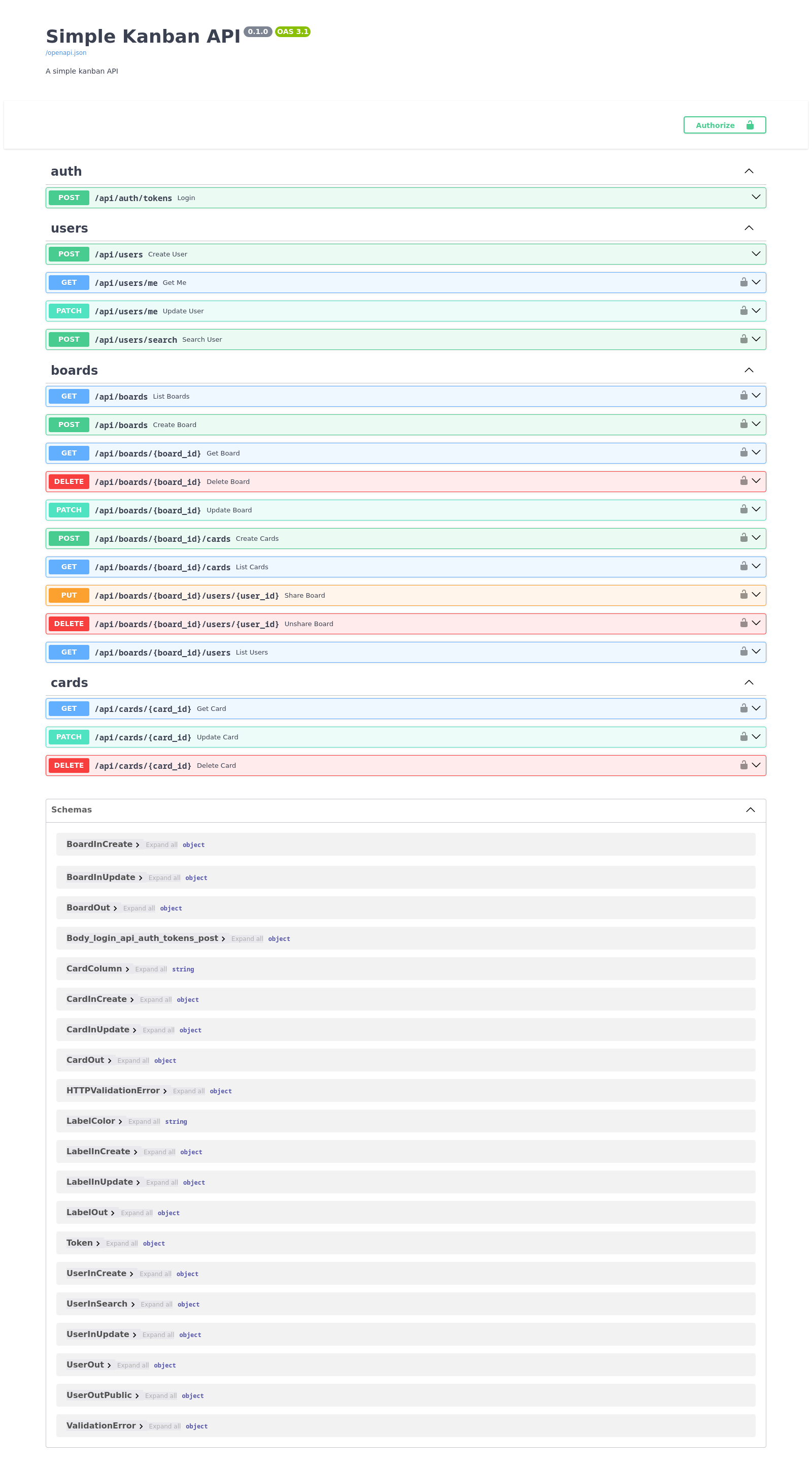 Auto-generated API documentation showing available endpoints